
Unplugged Wedding Ceremony: Photographer Backed Wording for Your Day
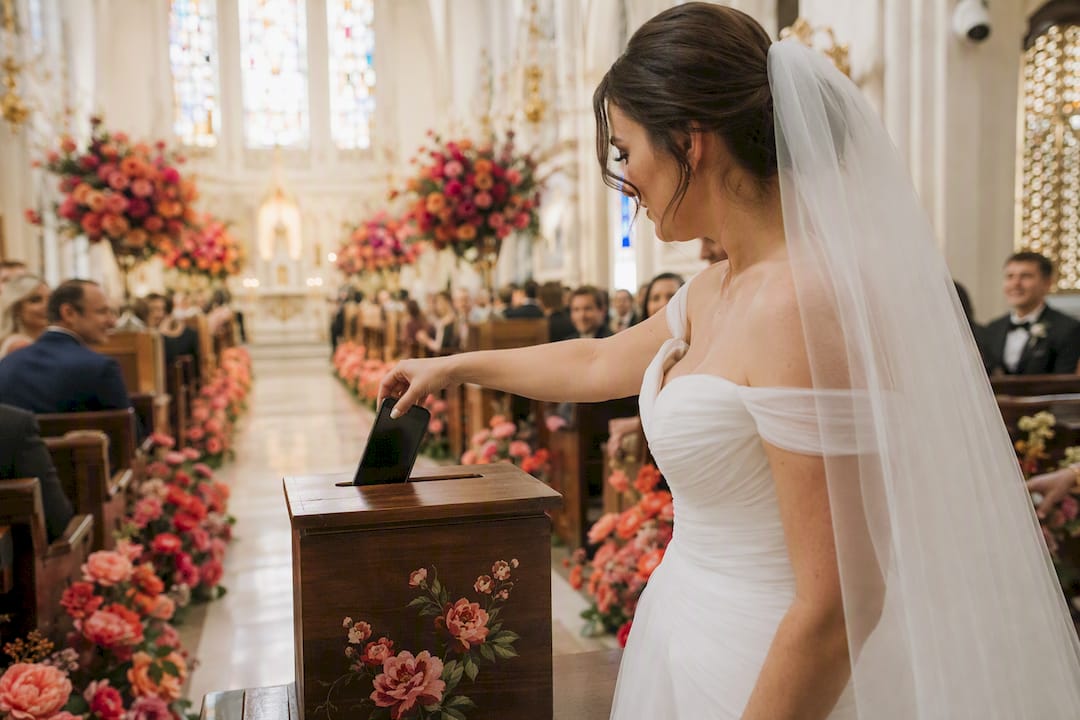
An unplugged wedding ceremony asks your guests to put phones, tablets, and cameras away while you exchange vows, so every eye in the room is on you rather than on a screen. The trade is simple: you gain presence and a gallery of unobstructed professional photos, and in return you accept that guests won't have their own snaps of the exact moment you kiss. For most couples working with a professional photographer, it's the right call, especially if you love the idea of guests actually watching you get married.
TL;DR:
- An unplugged wedding most effectively lasts during a brief window such as the ceremony, ideally just the vows or processional, to minimize guest resistance.
- Clear, warm communication through invitations, signage, and officiant announcements significantly increases guest compliance and overall experience.
- Having a detailed plan for managing phones with signage, ushers, and an officiant's verbal cue ensures better adherence and smooth coordination on the day.
- Confidential sharing of professional photos post-wedding alleviates guest disappointment over missing candid shots and maintains their connection to the day.
- Religious or multicultural traditions may require special considerations, so coordinate with officiants or venues beforehand to respect pre-existing protocols.
Table of Contents
- What does "unplugged ceremony" actually mean?
- The real benefits and genuine downsides of going unplugged
- How to tell guests: invitations, your website, and signage
- Making it stick on the day: announcements, ushers, and the phone drop
- Compromises that keep everyone happy
- A photographer's perspective on planning around an unplugged ceremony
- Wording you can copy for invitations, signs, and scripts
- A quick day-of checklist for organisers
- Cultural and religious considerations for an unplugged ceremony
- How going unplugged changes videography and official coverage
- Keeping guests engaged without their phones
- Legal and ethical points to consider around recording devices
- A photographer's note on presence and better photographs
- How Alex Gell handles the details of your unplugged ceremony
- Sources
- FAQ
What does "unplugged ceremony" actually mean?
The phrase covers a range of choices, not one fixed rule. Some couples keep it narrow: no devices during the ceremony itself, phones back out the moment you're pronounced married. Others extend the request through the speeches, or occasionally the whole day, though a full-day unplugged wedding is rare and can feel restrictive for guests who simply want a photo with the happy couple later on.
Most ceremonies run for a brief, manageable window, which is an appropriate length of time to ask anyone to switch off. That brevity is actually the strongest argument for going unplugged: you're not asking guests to abstain all evening, just for the length of a chapel talk.
Exceptions are worth deciding in advance rather than negotiating on the day. Grandparents who can't attend in person might need a livestream. A guest with a family emergency will keep their phone regardless, and trying to police that is a losing battle not worth fighting. The ultimate guide to unplugged weddings notes that couples who request an unplugged ceremony are usually motivated by two things: wanting to feel the day rather than watch it through a hundred strangers' screens, and wanting photos that actually look like the moment happened, not a moment interrupted by someone's elbow and iPhone.
Decide your scope, decide your exceptions, then communicate both clearly. Vague rules create more confusion than no rule at all, and a guest who wasn't told about the livestream carve-out will assume the ban applies to them too.
The real benefits and genuine downsides of going unplugged
The upside is bigger than "nicer photos". When a room full of guests isn't holding phones aloft, the atmosphere changes. People make eye contact. They react out loud instead of through a viewfinder. Couples routinely say the ceremony felt more emotional precisely because everyone was actually there, not filming it for later.
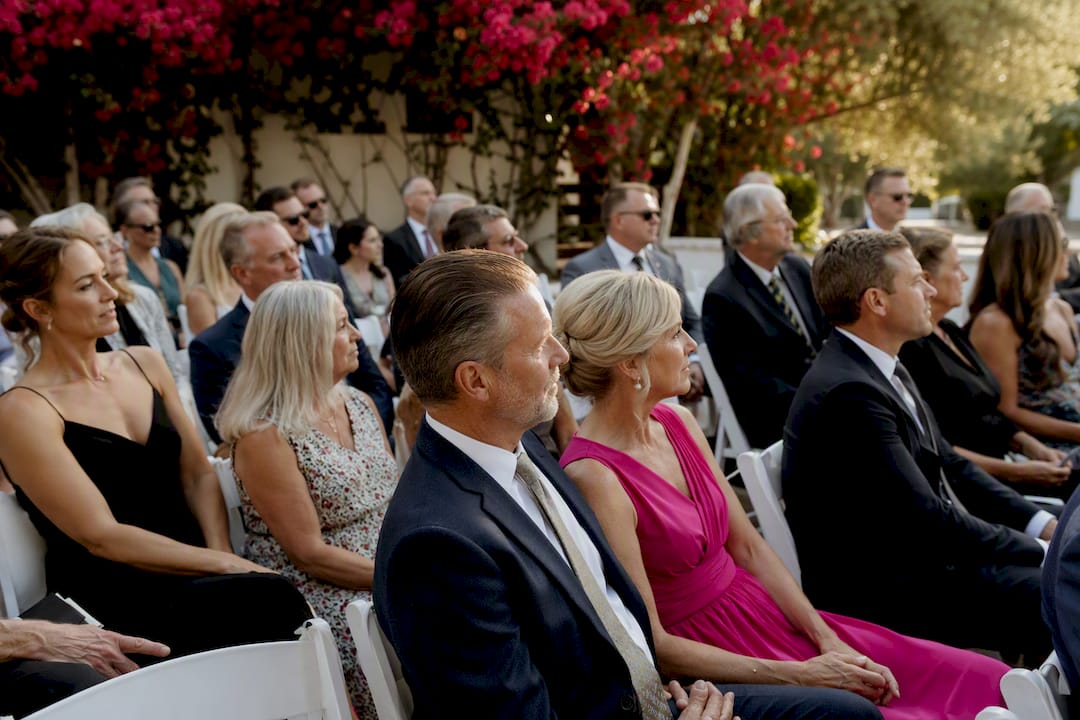
The photographic case is just as strong. A photographer's perspective on unplugged ceremonies points out that when one professional eye is capturing the moment instead of forty amateur ones, the final gallery is coherent. No sea of raised arms in your aisle shot. No stranger's phone screen glowing in the corner of your first kiss. You end up with a story told in one consistent visual voice rather than a scattered mix of blurry, badly lit phone photos competing with the images you actually paid for.
There are real downsides too, and it's worth naming them honestly rather than pretending an unplugged ceremony has no cost.
- Some guests feel micromanaged, particularly older relatives who see phone photos as a normal way of marking the moment, not an intrusion.
- You lose the candid, imperfect guest-shot photos: the one Auntie Jean takes from a wonky angle that somehow becomes everyone's favourite.
- Guests with mobility or hearing difficulties sometimes rely on a phone screen or recording to follow the ceremony from further back, so blanket bans can create accessibility problems if you're not careful.
None of these are reasons to abandon the idea. They're reasons to build in compromises. A pros-and-cons breakdown of unplugged weddings suggests the fix is straightforward: share your professional photos generously and quickly after the wedding, so guests never feel like they missed out on having their own copy of the day. Losing the phone doesn't have to mean losing the memory.
How to tell guests: invitations, your website, and signage
Guests don't resent an unplugged request when it's communicated well. They resent finding out about it for the first time as they're walking down the aisle. Layer the message across every touchpoint and adherence improves dramatically, according to the same ultimate guide to unplugged weddings that tracked what actually gets guests to comply.
Start early, then repeat the message closer to the day:
- Save-the-date or wedding website: a gentle first mention, framed as information rather than instruction, so nobody's caught off guard.
- Formal invitation: a short line if the wedding is fully unplugged, so guests can plan around it.
- Ceremony programme: the fullest explanation, since guests are reading this in their seats with a few spare minutes.
- Physical signage on the day: the final, unmissable reminder for anyone who skimmed the earlier notes.
Placement matters more than most couples realise. One sign at the venue entrance catches guests as they arrive, and a second beside the guest book reaches the ones who missed it while they were queuing to sign in, a tip echoed in guidance on unplugged ceremony etiquette. Keep the type large and the wording brief. A sign crammed with paragraphs of explanation won't get read; a single clear line will.
Tone is the detail most couples get wrong. A sign that reads like a rulebook ("NO PHONES. NO EXCEPTIONS.") puts guests on the defensive before they've even sat down. Framing it as an invitation, something closer to "we'd love for you to be fully present with us", reduces pushback considerably. Research into unplugged ceremony wording found that a grateful, warm tone gets far less resistance than an accusatory one, even when the underlying request is identical.
If your venue has tricky sightlines or a long aisle where guests at the back might feel tempted to zoom in with their phones, it's worth checking sightlines when you're choosing a location. Somewhere like the wedding venues across West Berkshire that offer clear views from every seat make the "just put it away, you'll see fine" argument much easier to make.
Making it stick on the day: announcements, ushers, and the phone drop
Signage alone doesn't work as well as couples hope. Guests skim past printed notices, especially when they're distracted, chatting, or seated further back. Passive cues need a human reinforcement to actually land, according to research into unplugged ceremony wording, and that's where the officiant comes in.
Here's the order of operations that works, from most to least effective:
- The officiant makes a verbal announcement immediately before the processional begins. This is, by a wide margin, the single most effective tool for compliance you have, more effective than any sign, according to photographers who run these ceremonies regularly. Guests are seated, attentive, and listening for cues about what happens next, which makes it the perfect moment to land the message.
- Ushers reinforce it quietly as guests are seated, particularly useful for anyone who arrived after the main announcement or wasn't paying attention.
- A phone-drop station, if you're running a fully unplugged event, gives guests somewhere to leave devices before they take their seats, an idea drawn from practical guest management strategies used by wedding planners.
- A trusted friend or coordinator intervenes directly if someone raises a phone mid-ceremony, but only as a last resort, and always discreetly rather than publicly.
Pro Tip: Brief your officiant with the exact wording you want used, and ask them to deliver it with warmth rather than authority. "We'd love you to put phones and cameras away so you can be fully present with us" lands far better than "Please switch off your phones."
If you're using a phone-drop box, ushers and volunteers can discreetly manage the logistics, and a labelled system with one trusted attendant collecting and returning devices removes most of the social awkwardness guests feel about handing over their phone in the first place.
Compromises that keep everyone happy
The single most popular compromise, and the one that resolves the most guest resistance, is the "one quick photo" rule. Invite guests to take a single shot as you walk down the aisle or the moment you're announced as married, then ask for devices away for the rest of the ceremony. A breakdown of unplugged wedding pros and cons describes this as the tactic experienced planners recommend most often, because it satisfies the guest instinct to capture a keepsake without letting that instinct dominate the whole ceremony.
Pair it with a promise, and mean it: professional photos will be shared afterwards, and reasonably quickly. That promise does a lot of the emotional work. Guests who know they'll see beautiful, properly lit images within a few weeks feel far less anxious about missing their own blurry version.
For family members who can't physically attend, a simple livestream from a tripod at the back of the room solves the presence problem without reopening the phone floodgates for everyone else. Keep it to one device, operated by one designated person, rather than letting "just for Nan" become an excuse for three cousins to film simultaneously.
Managed photo sharing after the event closes the loop. Whether that's a shared online gallery, a WhatsApp group, or simply emailing edited highlights within the first fortnight, giving guests generous access to real photos removes almost all the residual frustration about not shooting their own.
A photographer's perspective on planning around an unplugged ceremony
Every unplugged ceremony I shoot starts before the ceremony itself, with a proper conversation about timeline. I ask for exact song cues, when the vows happen, when there's a pause for that single guest photo, so I can plan angles and exposure around it rather than reacting on the fly. That advance planning is what separates a smooth unplugged ceremony from an awkward one.
On the day, adjustments still happen. If a phone appears somewhere I didn't expect, I'll shift position rather than make a scene, and I've learned which angles tend to stay clear even in a packed room. The inside view from wedding photographers is consistent on this point: a coherent gallery comes from consistent access, not luck.
The single biggest lever couples have is sharing a clear shot list and timeline with their photographer well ahead of the day. It sounds obvious, but it's the detail that most often gets skipped, and it's the one that makes the difference between a gallery that flows and one with awkward gaps.
Wording you can copy for invitations, signs, and scripts
Borrow and adapt these directly. Match the tone to your wedding, not the other way round.
- Invitation note: "We'd love for you to be fully present with us. Please keep phones and cameras away during the ceremony."
- Programme line: "Ours is an unplugged ceremony. We can't wait to share professional photos with you soon."
- Warm sign: "Phones away, please. We promise the professional photos will be worth the wait."
- Firm sign (for stricter ceremonies): "Unplugged ceremony in progress. No photos or recordings, please."
- Officiant script: "Before we begin, [names] have asked that you put phones and cameras away so you can be fully present with them today. Thank you for celebrating this moment together, without a screen between you."
Keep every version short. A sign or script that overexplains loses its authority; one clear sentence, delivered warmly, does more work than three defensive ones.
A quick day-of checklist for organisers
Print this and hand it to whoever's coordinating your day.
- Confirm signage is placed at the venue entrance and again near the guest book, so latecomers still see it.
- Brief the officiant on exact wording and timing, ideally the announcement lands right before the processional.
- Assign ushers to reinforce the message quietly as guests take their seats.
- If using a phone-drop station, label devices with numbered tags and assign one trusted attendant to manage collection and return.
- Agree in advance who intervenes if a guest ignores the request, and keep that person's approach low-key.
Cultural and religious considerations for an unplugged ceremony
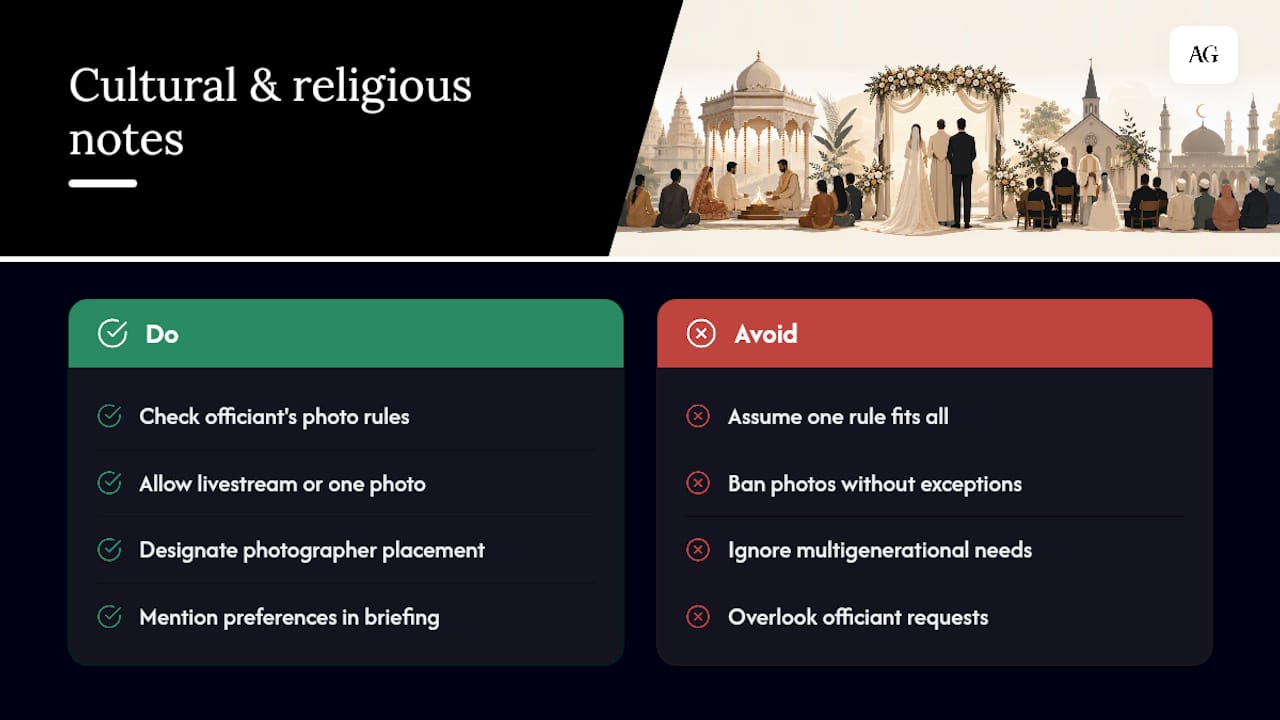
Not every tradition treats an unplugged request the same way, and it's worth thinking through your own before assuming a blanket rule fits. Some religious ceremonies already restrict photography as a matter of practice; officiants in certain Orthodox Jewish, Catholic, or Hindu ceremonies may have their own rules about where photographers can stand or when flash is permitted, independent of anything you request from guests. In these cases, your unplugged request often simply reinforces an existing expectation rather than introducing a new one.
Multi-generational or multicultural weddings sometimes carry a stronger expectation that relatives document the day themselves, particularly where family photo-taking is part of how celebrations are shared with relatives who couldn't travel. If that's true for your family, a stricter no-exceptions rule can cause real friction. A livestream or a clearly designated "one photo" moment tends to bridge that gap better than an outright ban.
It's also worth checking with your officiant directly, since religious officiants often have their own preferences about phones and cameras during specific rites, blessings, or readings that go beyond general etiquette. A rabbi, imam, priest, or celebrant may ask for stricter silence during a particular passage even if the rest of the ceremony is more relaxed. Build their preferences into your plan rather than assuming your general "unplugged" wording covers every moment automatically, and mention this during your initial briefing so nothing gets missed on the day.
How going unplugged changes videography and official coverage
An unplugged ceremony doesn't just protect your photographer's shots, it noticeably improves your videographer's footage too. Fewer raised phones means fewer obstructed sightlines in wide shots, cleaner audio without the ambient clicking of camera shutters, and none of the slightly comic problem of a wedding video showing dozens of other people's phone screens instead of the couple.
It does mean your official photographer and videographer become the sole record of the ceremony, which raises the stakes on preparation. Coordinate between them in advance so they're not competing for the same angle at the same moment, particularly during the vows and the first kiss. Ask your photographer to share their planned positions with your videographer, so each has a clear lane rather than crossing paths mid-ceremony.
This is also why briefing a shot list matters twice over: not only does it help your photographer plan exposure and timing, it means your videographer knows exactly when to expect the "one quick photo" pause, if you're using that compromise, so they can adjust framing rather than being caught out by a sudden crowd of raised phones breaking an otherwise clean unplugged shot.
Keeping guests engaged without their phones
Guests without phones to fiddle with actually need very little to stay engaged, a ceremony is short, and most people are naturally drawn in once they're not distracted. Still, a few touches make the difference between guests who feel present and guests who feel bored.
Give people something to do with their hands and eyes: a printed programme with the order of service, a reading, or a short note about the couple's story keeps attention on the ceremony rather than drifting toward a pocket. Music matters more than couples expect, a well-chosen processional or interlude fills the quiet moments that a phone might otherwise fill.
Seating and sightlines matter too. Guests who can actually see and hear clearly rarely reach for a phone to "check" what's happening. If your venue has awkward sightlines, consider a small riser for the ceremony or seating that angles toward the couple rather than straight rows facing forward, small adjustments that keep people watching rather than craning.
Legal and ethical points to consider around recording devices
Wedding ceremonies held on private venue property give the couple and venue considerable latitude to set their own rules about phones, cameras, and recording, since guests are attending as invited visitors rather than members of the public. That said, courtesy toward professional vendors matters as much as the rule itself: your hired photographer and videographer are working under a contract that typically grants them specific rights to the images and footage they capture, and a guest publishing their own competing recording can create genuine tension around who "owns" the moment.
Religious venues sometimes carry their own separate policies on recording during services, occasionally rooted in the sanctity of the ceremony rather than simple etiquette, and these can override anything the couple personally requests. It's worth checking directly with the officiant or venue about any existing rules before finalising your own wording, so you're reinforcing their policy rather than accidentally contradicting it.
Ethically, the clearest approach is transparency: tell guests what you're asking and why, well before the day, rather than springing a strict rule on them at the door. Most resistance to an unplugged ceremony comes from surprise, not the request itself.
A photographer's note on presence and better photographs
There's a moment in almost every unplugged ceremony I shoot where I look up from the camera and realise the whole room is doing the same thing, watching, not filming. That shift is real, and it changes how the day feels for everyone in it, not just the couple.
It changes the photographs too. Faces are turned toward the couple, not angled at a screen. Reactions are genuine because nobody's mediating them through a lens. That's the difference between a gallery of technically fine photos and one that actually tells the story of your day. If you're weighing up whether an unplugged ceremony fits your wedding, I'm always happy to talk through what's worked for other couples.
— Alex
How Alex Gell handles the details of your unplugged ceremony
Running an unplugged ceremony well takes coordination, not just a nice sign, and that's exactly where working with an experienced photographer earns its keep. Alex Gell builds the unplugged plan into the timeline from the first conversation: briefing your officiant on wording and timing, agreeing where ushers stand, and mapping out the "one quick photo" moment if you're using that compromise, so nothing catches anyone off guard on the day.
You get a photographer who's already planned for the moment a phone appears unexpectedly, who knows how to hold position without breaking the flow of your ceremony, and who delivers a coherent, unobstructed gallery precisely because the interference was managed before it happened. That's the practical payoff of hiring someone who's run this exact scenario many times over, not just someone who owns a good camera.
Browse the wedding photography portfolio to see how unplugged ceremonies translate into calm, emotive galleries, check the F&Q's for common questions about how the day runs, or head straight to wedding enquiries to check availability for your date and start planning your own unplugged ceremony.
Sources
- What is an unplugged wedding ceremony and how can you enforce one?
- Unplugged wedding pros and cons
- The ultimate guide to unplugged weddings
- Unplugged wedding ceremony etiquette: How to ask guests
FAQ
What does it mean when a wedding ceremony is unplugged?
It means guests are asked to put phones, tablets, and cameras away for the ceremony so they're fully present and don't obstruct the professional photographer's shots.
How do you politely say "unplugged ceremony" to guests?
Frame it as an invitation rather than an instruction, something like "we'd love for you to be fully present with us today, so please keep phones away during the ceremony" lands far better than a blunt ban.
What are the cons of an unplugged ceremony?
The main downsides are that some guests feel controlled, candid guest-shot photos are lost, and guests with accessibility needs may occasionally rely on a device to follow the ceremony, though sharing professional photos promptly afterwards resolves most of the frustration.
How do you say no phones during a ceremony without sounding harsh?
Keep signage and scripts short and grateful in tone rather than accusatory, "phones away, please, we promise the photos will be worth it" reads as warm rather than controlling.
Who should make the announcement about no phones?
The officiant, delivered immediately before the processional begins, since a verbal announcement at that moment is the most effective compliance tool available, far more so than signage on its own.
