
Second Shooter for UK Weddings: A Pro Explains the 100 Guest Rule
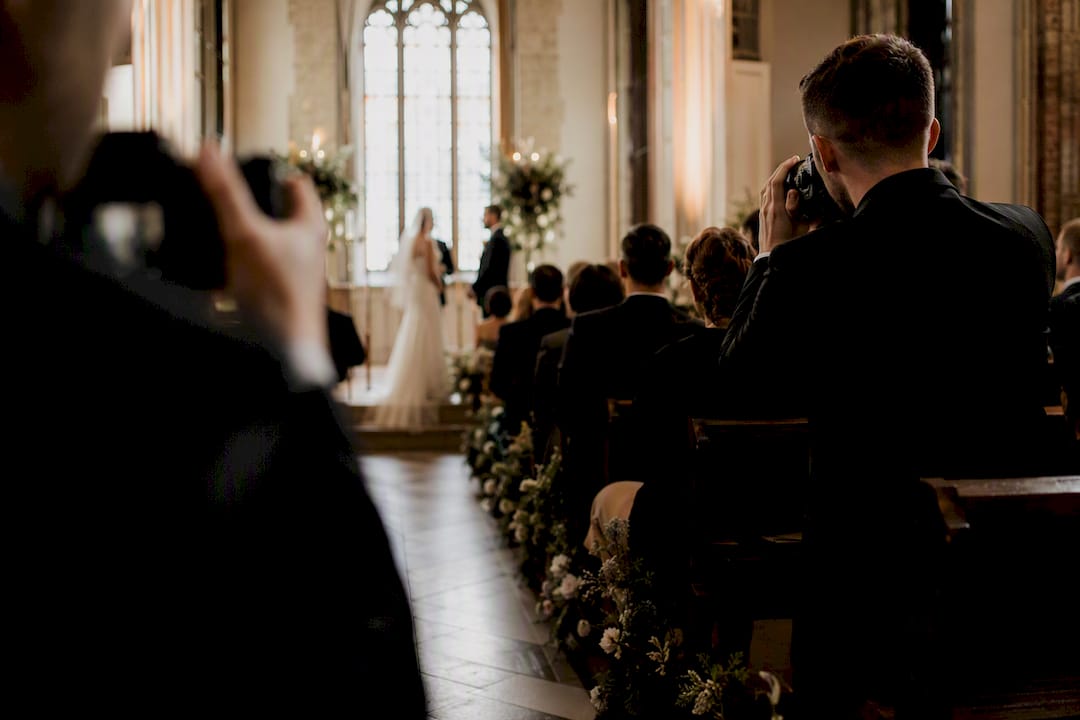
Yes, if your day involves split prep, more than 100 guests, or multiple locations, a second shooter earns its cost many times over. You get parallel coverage while you and your partner get ready separately, extra angles at the ceremony, and someone catching guest reactions your lead photographer will always miss. For a small, single-location elopement, it's genuinely optional. Below, I'll walk you through the role, the price, and exactly what to ask before you book one.
TL;DR:
- Second shooters are essential for weddings with more than 100 guests, multiple locations, or extended event coverage to ensure comprehensive and diverse photo documentation.
- They provide additional angles during key moments, capture guest reactions, and increase safety against gear failures, significantly enhancing overall coverage quality.
- Coordinating equipment, synchronized file formats, and clear expectations beforehand are critical for seamless integration into the photography team.
- Costs typically range from flat day rates, hourly fees, or a percentage of the total, with prices rising for destination or multi-day events; confirm detailed deliverables and expenses upfront.
- A well-managed second shooter's behavior, attire, and communication directly impact guest experience and the smooth operation of the day.
Table of Contents
- What does a second shooter do at a wedding?
- What do you actually gain from a second shooter?
- Gear, sync, and file handling: what to expect
- How much does a second shooter cost?
- Hiring checklist: what to confirm before the day
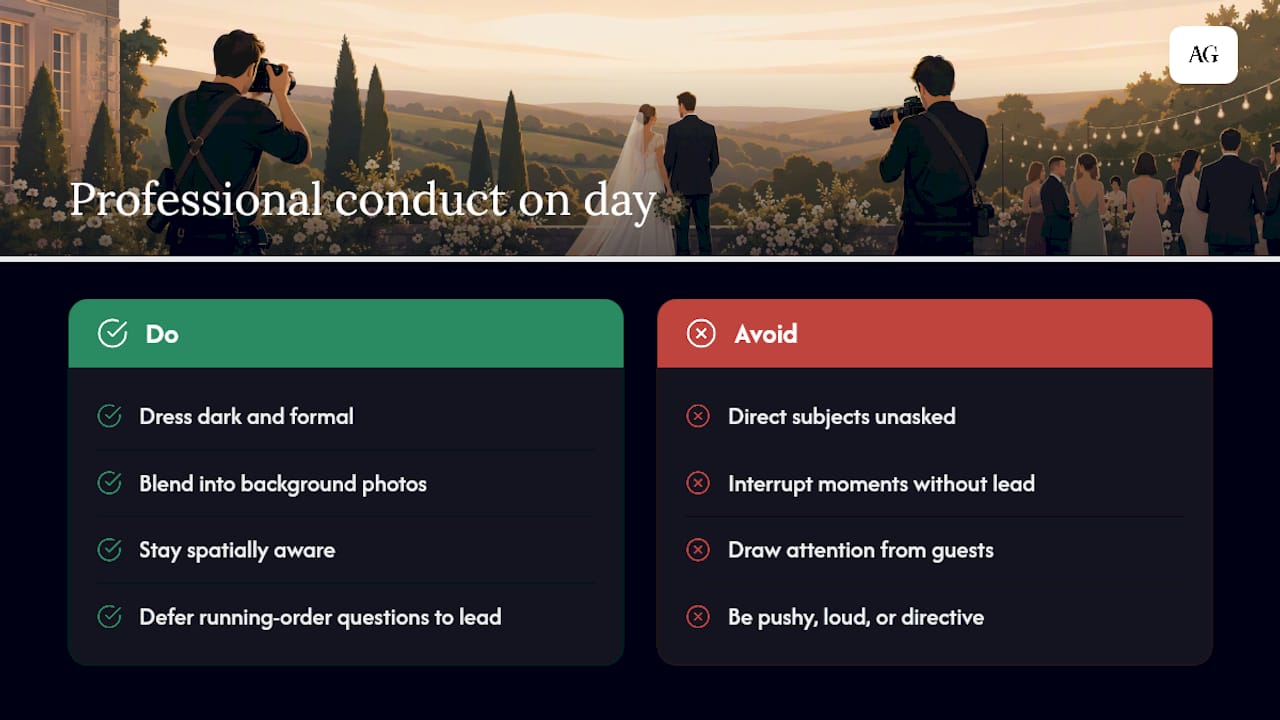
- Professional conduct on the day
- What happens to the photos after the wedding?
- Author perspective: how I use second shooters for high-end weddings
- How to book second-shooter coverage with Alex Gell
- Sources
- FAQ
What does a second shooter do at a wedding?
A second shooter isn't just an extra pair of hands. Working under the direction of your lead photographer, they cover angles and moments your main photographer physically cannot be in two places for. On a typical wedding day, that means:
- Photographing groom or partner prep while the lead covers the other side
- Shooting the ceremony from behind or beside guests, capturing reactions the lead's angle misses
- Catching candid guest moments, table details, and venue atmosphere during the reception
- Grabbing wide establishing shots while the lead focuses tight on the couple
- Stepping in as backup if the lead's gear fails or an unexpected moment happens simultaneously elsewhere
It helps to know the difference between an assistant, a second shooter, and an associate photographer. An assistant carries kit and holds lights but rarely shoots. A second shooter takes their own frames under the lead's creative brief. An associate often works more independently, sometimes covering entire weddings solo under someone else's brand.
What ties it together is what the industry calls "lead-first" etiquette: a good second shooter follows the lead's brief, stays out of their key frames, and never competes for the same shot. It's a supporting role by design, not a rival one.
What do you actually gain from a second shooter?
The honest answer is a fuller, richer story of your day, not just more photos. When two photographers cover prep at different locations, you get real, unposed moments from both sides instead of one photographer rushing between rooms.
At the ceremony, having a second angle means you get your partner's face as you walk down the aisle, not just your own back. That reversed perspective is often the single most requested shot couples wish they'd had.
Beyond the obvious variety, a second shooter brings:
- Guest reactions and candid laughter that a solo photographer, focused on the couple, simply doesn't see
- Environmental and detail shots (the venue, the food, the flowers) captured while the lead stays with you
- Faster formal group photos, since one photographer organises while the other shoots
- A safety net if a camera fails, a card corrupts, or the lead needs a break during a 12-hour day
- Considerably better coverage at large or multi-location weddings, where one person alone cannot be everywhere that matters
Pro Tip: If your ceremony and reception are at different venues, or your guest list tops 100, treat a second shooter as close to essential rather than a nice extra. The larger and more spread out the day, the more a single photographer's coverage thins out.
Second shooting also functions as an entry point into the industry. Many second shooters are building experience and portfolios while working under an experienced lead, which is part of why the arrangement tends to be more affordable than booking two full lead photographers.
Gear, sync, and file handling: what to expect
Your lead photographer coordinates this, but it helps to know what "professional standard" actually looks like behind the scenes. A second shooter arriving without matching equipment or a plan for merging files creates real headaches in editing, so most experienced leads set clear expectations before the day even starts.
- Compatible kit. Two camera bodies, a mix of lenses covering wide and portrait ranges, an on-camera flash for low light, and enough spare batteries and memory cards to last the full day without a mid-reception scramble.
- Clock synchronisation. Both photographers sync their camera clocks to the same second before the day begins, so files from both cameras sort correctly when merged into one timeline during editing.
- Matching file conventions. Shooting in the same RAW format, with an agreed white balance or grey card reference and similar colour settings, reduces the friction of blending two photographers' work into one cohesive gallery.
- File handover. Cards, an SSD, or a secure cloud transfer, agreed in advance, with the second shooter responsible for keeping a backup copy until the lead confirms safe receipt.
These technical protocols aren't bureaucracy for its own sake. Skip them, and your lead photographer spends hours correcting colour mismatches instead of curating your gallery.
How much does a second shooter cost?
Second shooters are typically paid in one of three ways: a flat day rate, an hourly rate, or a percentage of the total contract value. Which model applies usually depends on how the lead photographer structures their own pricing and how long the day runs.
Rates vary by region and experience, but representative mid-market ranges exist across the industry, with luxury events, overnight coverage, and significant travel all pushing the price upward. A second shooter for an eight-hour local wedding costs noticeably less than one booked for a destination wedding spanning two days.
When you're reviewing a quote that includes second-shooter coverage, confirm:
- The exact number of hours covered, and the overtime rate if the day runs long
- Whether travel costs are included or billed separately
- What deliverables you actually receive from the second shooter's files, not just the lead's
- Whether meals and parking are covered in the fee or added afterwards
Ask your photographer directly rather than assuming. Our F&Q's page covers exactly this kind of payment and deliverables question if you want a starting reference point.
Hiring checklist: what to confirm before the day
A second shooter arrangement runs smoothly when expectations are written down, not assumed. Before you sign anything, get clear answers on:
- Who is responsible for which parts of the day, so coverage doesn't overlap or leave gaps
- Whether the second shooter can use any images in their own portfolio, and if so, when
- How long turnaround takes for the combined gallery once both photographers deliver files
- Whether the second shooter carries their own public liability insurance
- What the backup plan is if either photographer falls ill or equipment fails
Get these in writing. Copyright and portfolio usage are commonly controlled by the lead's contract, and in most UK arrangements, the lead photographer retains copyright while the second shooter needs explicit written permission before posting any images publicly.
Your contract should also specify:
- Payment schedule and what happens if the day overruns
- Cancellation terms for both parties, including illness or emergency contingency
- Arrival time, dress code, and any "no-shoot" zones the couple wants respected
For the practical side of dress code and unobtrusive behaviour, our guide on event photographer dress code covers what's reasonable to specify. And if you haven't already, our piece on questions to ask a wedding photographer is worth reading alongside this checklist.
Professional conduct on the day
A second shooter's job isn't only technical. How they carry themselves shapes your experience of the day as much as the photographs do. Professional standards call for dressing unobtrusively, in dark, formal clothing that blends into the background rather than standing out in guest photos or getting in the way of the video team.
Spatial awareness matters just as much. A well-trained second shooter reads the room, anticipates where the lead is heading next, and never directs subjects or interrupts a moment unless the lead specifically asks them to step in. If a guest asks them a question about timings or the running order, the answer should be helpful but brief, deferring anything substantial to the lead or the wedding planner.
Communication before the day matters too. A second shooter who has walked through the timeline with the lead, discussed the couple's priority shots, and agreed on where each person will stand during key moments (the first kiss, the confetti exit, the speeches) avoids the awkward scramble of two photographers converging on the same three feet of floor.
During quieter moments, the best second shooters use the time productively. Rather than standing idle, they scout upcoming locations, check lighting for the next segment, or quietly review shots on the back of the camera to catch focus issues early. None of this should ever draw attention away from you and your guests. If a second shooter is memorable to your guests for the wrong reasons, being pushy, loud, or overly directive, that reflects on the whole photography team, not just them.
What happens to the photos after the wedding?
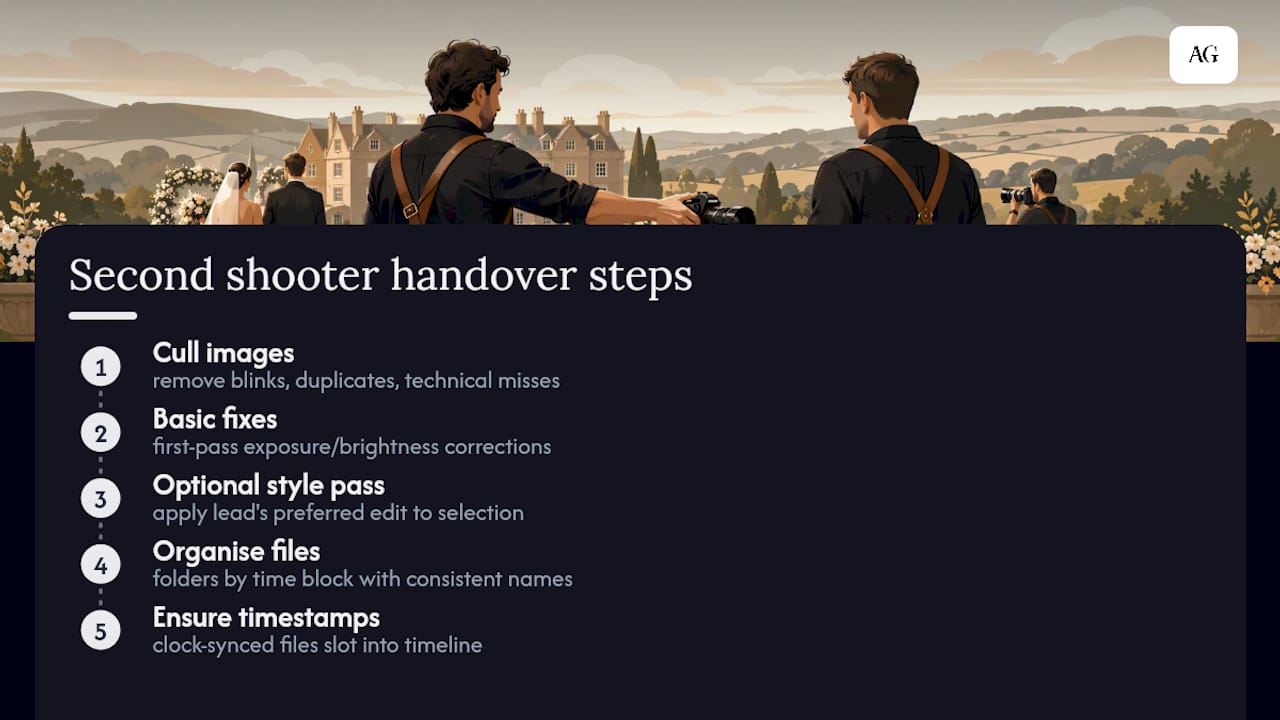
The day doesn't end when the last dance does. A second shooter is typically expected to hand over organised, labelled files rather than a raw dump of thousands of unsorted images. That usually means culling out blinks, duplicates, and technical misses before delivery, sometimes with a first pass of basic exposure correction.
Delivering pre-culled, well-organised files makes a second shooter measurably more valuable to the lead photographer, because it saves hours of sorting during an already demanding editing week. Some second shooters go further and apply the lead's preferred editing style to a trimmed selection before handover, though full retouching and colour grading almost always stays with the lead to keep the final gallery consistent.
File organisation matters too. Folders sorted by time block (prep, ceremony, reception) with consistent naming make it far easier for the lead to merge both photographers' work into one seamless timeline. This is where the earlier clock synchronisation pays off: correctly time stamped files slot into the gallery in the right order automatically, rather than requiring manual reordering.
For couples, this workflow is largely invisible, but it directly affects how quickly you get your photos back. If you're curious about typical turnaround, our page on when you'll get your wedding photos back explains what affects delivery timing, second shooter or not.
Author perspective: how I use second shooters for high-end weddings
I don't treat second-shooter coverage as an add-on I bolt onto a booking. It's a deliberate creative decision, and I brief every second shooter on the story I'm trying to tell before the day starts, not just the shot list.
For editorial-documentary weddings, that usually means assigning them the reversed ceremony angle, groom or partner prep, and candid guest reactions during speeches, the moments I simply cannot be present for myself. I ask them to match my file conventions and sync clocks with me every time, because a mismatched gallery is the fastest way to break the flow of a couple's story.
Quality control isn't optional here. If a second shooter's style doesn't sit comfortably alongside my editorial approach, I won't use them, regardless of how technically competent they are. Consistency across every frame in your gallery matters more than having an extra camera on site.
— Alex
How to book second-shooter coverage with Alex Gell
If you've read this far, you already know a second shooter isn't a luxury tacked onto a package, it's how you get the full story of your day rather than half of it. Second-shooter coverage is often included in weddings where the guest count, venue layout, or timeline genuinely calls for it, briefed personally so the style stays consistent from first look to last dance.
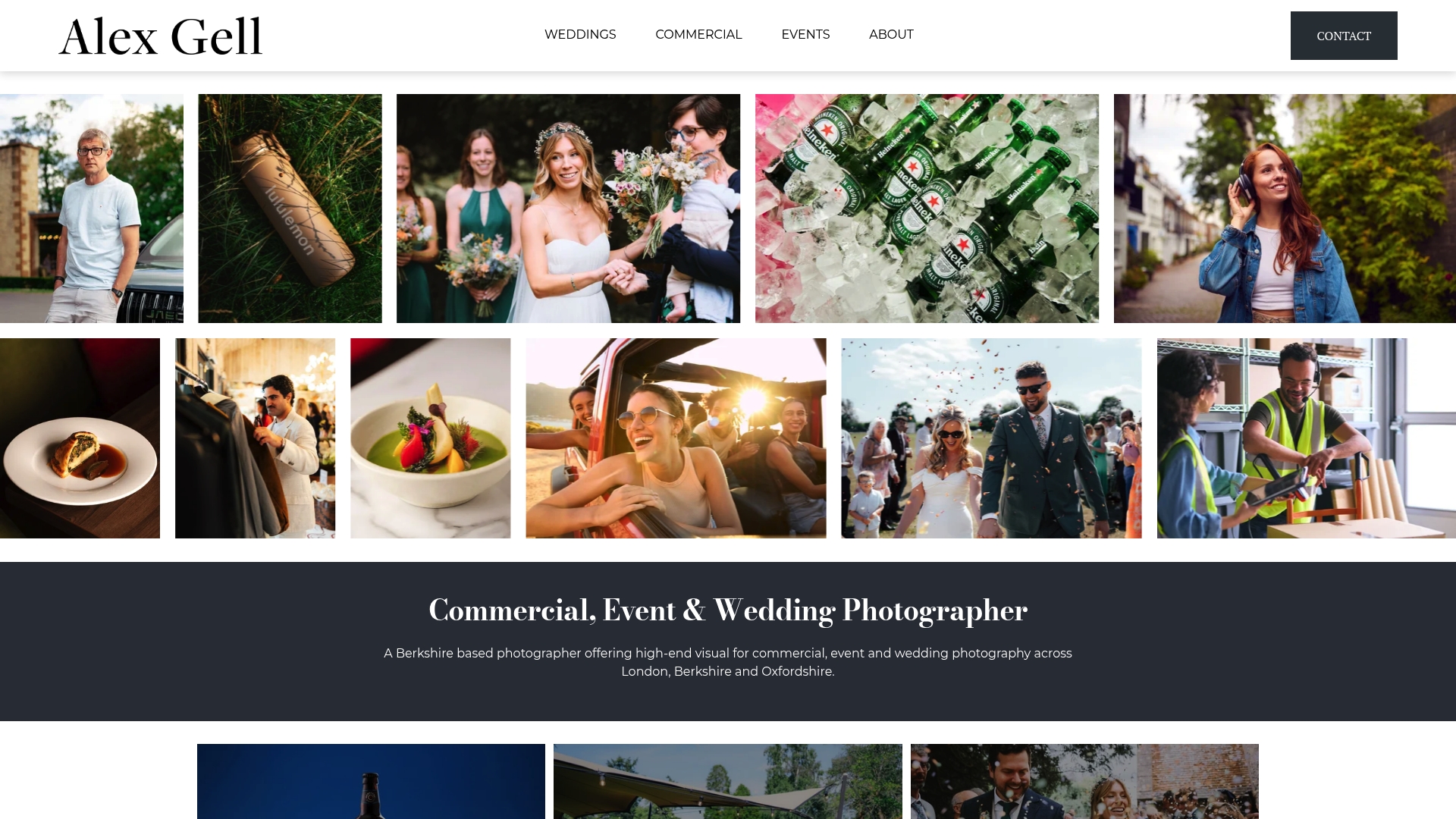
When you enquire, mention your guest count and whether your ceremony and reception happen at different venues. That's the fastest way to get an honest answer on whether a second shooter suits your day, rather than a generic upsell. You can see examples of multi-photographer coverage in the wedding photography portfolio, and if you're ready to check dates, head to wedding enquiries to start the conversation.
Sources
- How to be a good second shooter for a wedding: the professional guide
- Second shooter guide: working as an assistant photographer
- Thinking about second shooting weddings? Here's what you need to know first
- The complete guide to the wedding photo second shooter: roles, rates, and 2025 trends
FAQ
How much should a second shooter get paid?
Second shooters are usually paid a flat day rate, an hourly rate, or a percentage of the total contract value, with representative mid-market ranges varying by region, experience, and event length. Luxury events, overnight coverage, and travel often increase the fee.
What is the 30-minute rule for weddings?
This refers to building a buffer of time into your timeline around key moments like formal photos or the ceremony start, giving photographers room to adapt if the day runs behind schedule. It isn't a fixed industry standard, but experienced photographers, including second shooters, generally build this kind of flexibility into the running order.
Is there a second shooter at my wedding?
That depends entirely on your package. Some photographers include a second shooter as standard for weddings over a certain guest count or duration, while others offer it as an optional add-on you request separately, so it's worth confirming directly during booking.
What's the difference between a second shooter and an assistant?
An assistant carries equipment and helps set up but rarely shoots independently, while a second shooter takes their own frames under the lead photographer's creative direction. A second shooter's role is closer to a junior photographer than a helper.
Do I need a second shooter for a small wedding?
For an intimate, single-location wedding with a smaller guest list, a second shooter is optional rather than essential, since one skilled photographer can usually cover the day comprehensively. It becomes far more valuable once guest numbers climb past 100 or your day spans multiple venues.
