
Event Photographer Dress Code: What to Specify When Hiring
Your hired photographer should wear smart, discreet attire that matches your event's formality. That is the short answer. Add this one line to your booking brief right now: "Please wear [black tie / formal / smart-casual / business attire] appropriate to the event; confirm your outfit with us 7–14 days before the date." Two quick points before you read further:
- Who confirms: you (the host or planner) confirm attire requirements; the venue confirms any safety or access rules that affect what the photographer may wear.
- When to confirm: send your final attire confirmation in the week or two before the event, alongside logistics such as arrival time and access passes.
Alex Gell Photography, which operates across London, Berkshire, and Oxfordshire, follows this exact process on every booking. Where events involve children, a DBS check and public liability insurance are standard checks to request. HSE venue rules may also restrict footwear or require PPE in certain spaces, so it pays to ask early.
Key takeaways
A professional event photographer should wear smart, discreet attire matched to your event's formality, confirmed in writing one to two weeks before the event.
| Point | Details |
|---|---|
| Use a one-line brief | Paste a single attire sentence into your booking email specifying formality level. |
| Confirm in writing | Agree attire, venue rules, and any branded requests one to two weeks before the event. |
| Include a contract clause | Cover attire expectations, PPE compliance, and fee disclosure for special requests in the agreement. |
| Check compliance early | Request public liability insurance and DBS evidence (where relevant) at the same time as attire confirmation. |
| Alex Gell Photography | Covers London, Berkshire, and Oxfordshire with a pre-event brief process that includes attire, access, and venue compliance. |
Table of Contents
- What should an event photographer wear at each formality level?
- What practical venue rules affect a photographer's outfit?
- How do you specify photographer dress code in a brief and contract?
- What questions should you ask, and what are the red flags?
- How do you handle last-minute changes or an inappropriately dressed photographer?
- What safeguarding and compliance checks touch on dress and ID?
- What hosts often get wrong about photographer dress expectations
- Ready to book a photographer who gets the details right?
- Useful sources and further reading
What should an event photographer wear at each formality level?
The right photographer attire guidelines depend entirely on your event's tone; for official roles requiring professional appearance standards, consider examples like the Women's Professional Officiant Outfit - OrdainedPro. A photographer who turns up to a black-tie gala in chinos stands out for the wrong reasons. Here is a clear breakdown by formality, with a brief phrase you can paste directly into your booking email.
| Event type | Expected photographer attire | Brief phrase to paste |
|---|---|---|
| Black tie / gala | Black dinner suit or dark formal dress; polished shoes | "Please wear black tie or equivalent formal dress." |
| Formal / cocktail | Dark suit or smart dress; no trainers | "Please wear a dark suit or smart formal outfit." |
| Smart-casual | Pressed trousers, collared shirt or blouse; clean shoes | "Please wear smart-casual: collared shirt, pressed trousers." |
| Casual / outdoor | Smart jeans, plain top, clean trainers acceptable | "Smart-casual minimum; weather-appropriate layers welcome." |
| Corporate / conference | Business attire: suit, blouse, or equivalent | "Please wear business attire consistent with our delegates." |
Non-reflective, dark clothing is worth requesting for evening events regardless of formality. A photographer in a pale shirt catches light and draws eyes during speeches or first dances. Dark tones keep them unobtrusive while they work.
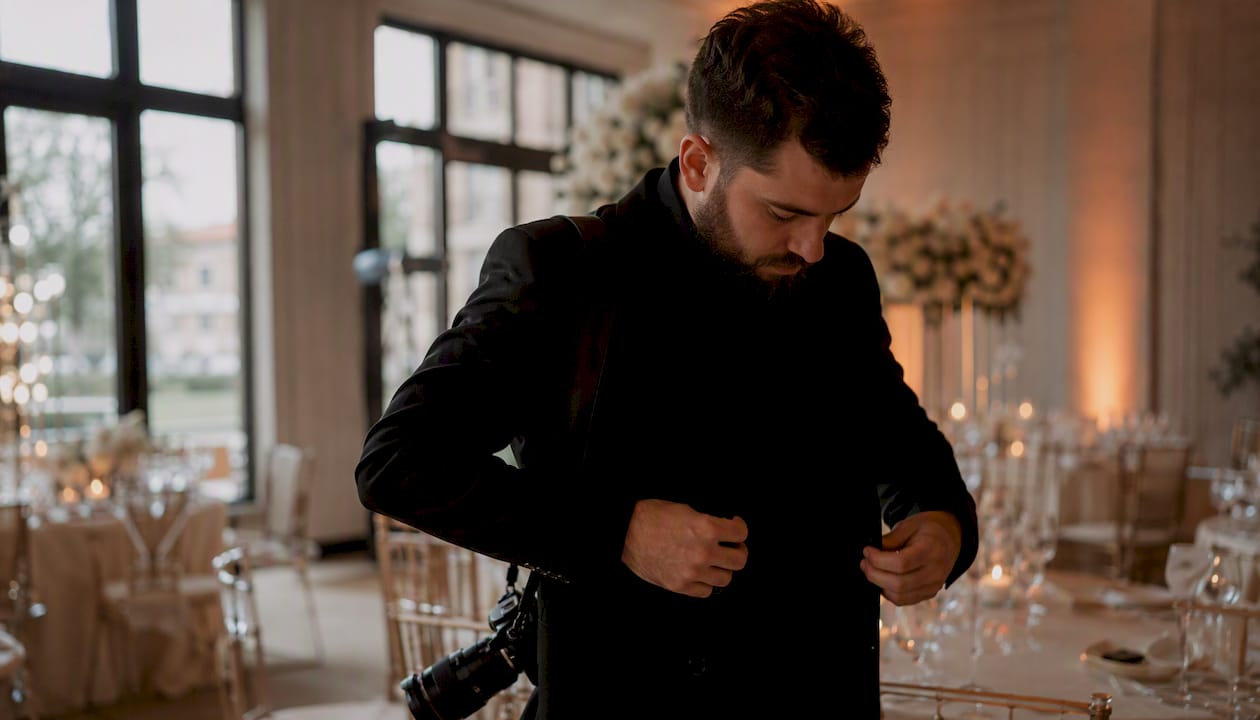
Some corporate clients ask for branded lanyards or logoed clothing. This is perfectly reasonable, though it is worth knowing that requests for a photographer to purchase or rent specific branded items are normally negotiable and may carry an additional fee. Flag this in your brief early so there are no surprises.
Cultural or religious dress sensitivities are best handled with a short, explicit note in the brief and a quick pre-event conversation. Clarity here avoids any awkwardness on the day and shows respect for the photographer's own needs too.
What practical venue rules affect a photographer's outfit?
Attire is not purely about appearance. Venues impose real constraints, and a photographer who cannot access a space because of their footwear or clothing is a problem you want to avoid.
Checklist of practical constraints to brief your photographer on:
- Non-slip, closed-toe footwear for wet or polished floors (many historic venues and marquees require this)
- No dangling jewellery or loose scarves that could snag on equipment or catch in crowd movement
- Dark, non-reflective clothing for low-profile coverage at evening events
- Pockets or a belt holster for small kit (lens caps, memory cards) to avoid bag clutter
- Freedom of movement for stairs, crouching, and quick repositioning
Venue questions to confirm before the event:
- Does the venue require contractors to wear an ID lanyard or visitor pass?
- Are there PPE requirements for any areas (e.g. outdoor production zones, kitchens, backstage)?
- Are there floor surface restrictions that affect footwear (e.g. sprung dance floors, heritage stone)?
- Is there an outdoor contingency that requires weather-appropriate layers?
- Does the venue require proof of public liability insurance before granting access?
Venues commonly require external contractors to follow their health and safety rules, which can include specific footwear or head cover in certain spaces. Confirm these details with your venue coordinator and pass them to the photographer in writing. If a formal or branded wardrobe request means the photographer must buy or hire something specific, note in the brief that any additional cost will be agreed before the event.
Pro Tip: Ask your venue coordinator for a written contractor briefing sheet. Pass it directly to the photographer at least a week before the event so there are no access surprises on the day.
How do you specify photographer dress code in a brief and contract?
Clear wording in your booking agreement protects both sides. Here are copy-ready lines for each stage.
Sample brief sentences by formality (paste into your booking email):
- Black tie: "We require black tie or equivalent formal dress for the duration of the event."
- Formal/cocktail: "Please wear a dark suit or smart formal outfit; no casual wear."
- Smart-casual: "Smart-casual dress is required: collared shirt or blouse, pressed trousers or skirt."
- Corporate: "Business attire consistent with our delegates and speakers is required."
Sample contract clause:
Aim to agree and confirm attire in the final confirmation exchange, roughly one to two weeks before the event. Safety and venue rules are non-negotiable: the photographer must comply with HSE requirements and venue contractor policies. Appearance preferences (specific colours, branded items) are negotiable and may cost extra. Get any agreed extras confirmed in writing.
What questions should you ask, and what are the red flags?
A short conversation at booking saves a lot of stress on the day.
Questions to ask at booking:
- Have you worked at this venue (or a similar formality level) before?
- Will you confirm your outfit with us in the week before the event?
- If the venue requires PPE or a specific lanyard, are you comfortable with that?
- If we request branded clothing, can you accommodate that, and what would the cost be?
- Do you hold public liability insurance, and can you provide a certificate if the venue requires it?
Red flags to watch for:
- Resistance to including a simple attire clause in the contract
- Vague or evasive answers about venue safety compliance
- No mention of cost when asked about a major wardrobe change (branded uniform, hired formal wear)
- Poor communication in the lead-up to the event, especially around logistics confirmation
A professional photographer will respond clearly: confirm the formality level, flag any genuine constraints (mobility, safety), and disclose any fee for special requests. Small, temporary adjustments, such as adding a blazer for a formal reception or removing a branded cap for a ceremony, are normally done without extra charge. That kind of adaptability is a good sign.
How do you handle last-minute changes or an inappropriately dressed photographer?
Stay calm and follow a clear sequence.
If the photographer arrives in attire that does not match the agreed brief, speak to them privately and directly: "Our brief specified [X]. Can you make a quick adjustment before we begin?" Most professionals will have a backup option or will make a small change on the spot.
If the issue cannot be resolved quickly, escalate in this order: contact your venue manager to confirm whether the attire breaches any access rules, then refer to the contract clause you agreed. If the photographer declines to comply with a clear, pre-agreed clause, you may be entitled to remedies under the booking contract, including a partial refund proportionate to the impact on the event.
For substitutions (where a different photographer covers the booking), confirm their name, ID, and attire on arrival before the event begins. Venues may require their own contractor ID check, so have the lanyard or pass ready. Minor, non-harmful deviations from the brief, such as a slightly different shade of suit, are worth accepting gracefully. Save the contract clause for genuine mismatches that affect guest experience or venue access.
What safeguarding and compliance checks touch on dress and ID?
A few compliance checks are directly relevant to what a photographer wears and carries on the day.
- DBS checks: if your event involves unsupervised access to children or vulnerable adults, request evidence of a current DBS check before confirming the booking. This is a standard, reasonable ask.
- Public liability insurance: request a certificate confirming cover, particularly for events with significant guest numbers or production equipment. Venues often require this before granting contractor access.
- Venue H&S compliance: include a clause in your brief requiring the photographer to comply with all venue health and safety rules, including any PPE or head cover requirements for specific areas.
- ID and lanyards: ask whether the venue requires contractors to wear an ID lanyard or visitor pass, and confirm this with the photographer in advance. Venues may refuse access without it.
Pro Tip: Collect the photographer's public liability insurance certificate and DBS evidence (where relevant) at the same time you confirm attire, roughly one to two weeks before the event. One confirmation email covers everything.
What hosts often get wrong about photographer dress expectations
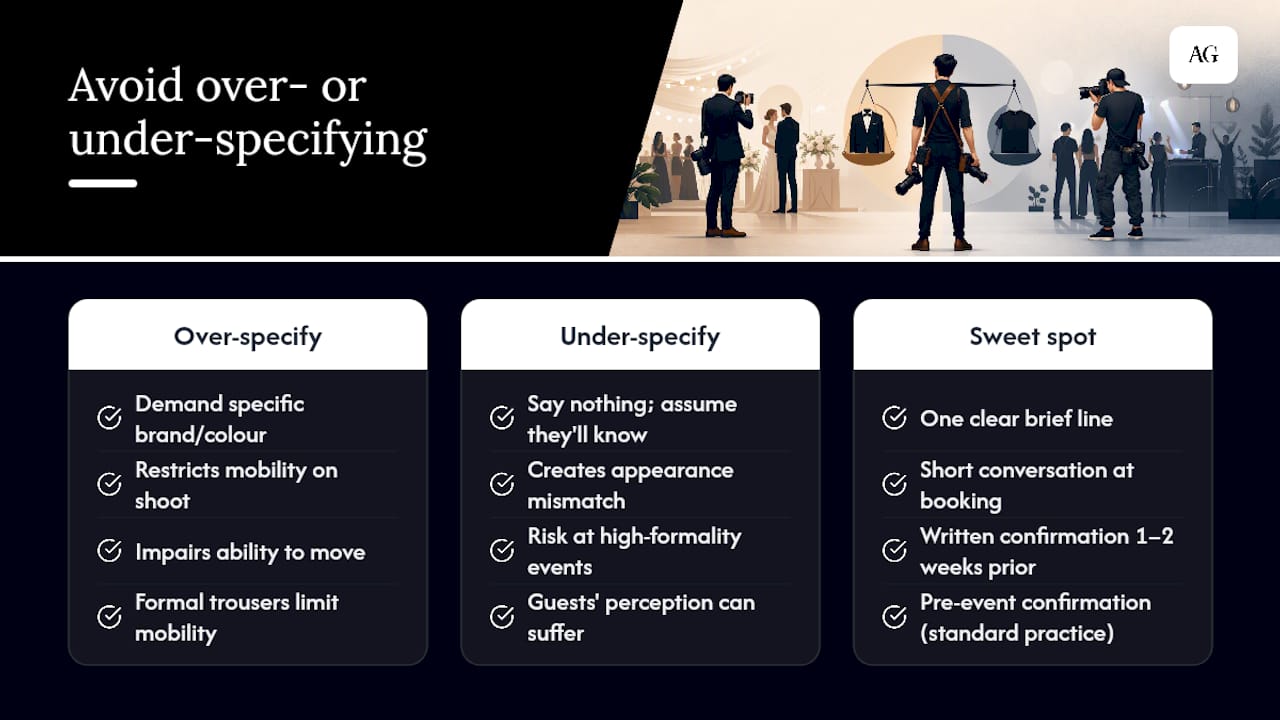
There is a tendency to either over-specify or say nothing at all. Both cause problems.
Over-specifying, such as requiring a specific brand of suit or a precise colour match to the wedding party, puts a photographer in an awkward position and can genuinely affect their ability to move freely and do their job well. A photographer crouching on a marble floor in hired formal trousers is not going to get the same shot as one dressed practically. The goal is smart and discreet, not matching the décor.
Under-specifying is the more common mistake. Saying nothing and assuming the photographer will "just know" what to wear leaves room for a genuine mismatch, particularly at high-formality events where appearance really does affect how guests perceive the whole production.
The sweet spot is a single, clear brief line, a short conversation at booking, and a written confirmation a week or two before the event. That is genuinely all it takes. At Alex Gell Photography, every booking includes a pre-event confirmation that covers attire, access, venue rules, and logistics in one exchange, so nothing is left to chance. You can see how that looks in practice across the corporate and event portfolio.
Ready to book a photographer who gets the details right?
Alex Gell Photography covers events in London, Berkshire, and Oxfordshire, from black-tie galas to corporate conferences and intimate celebrations. Every booking includes a pre-event brief confirmation covering attire, venue access, and logistics, so you know exactly what to expect before the day arrives.
Alex holds public liability insurance and is happy to provide documentation for venue compliance checks. DBS evidence is available on request for events involving children. Whether you are planning a product launch, an awards evening, or a wedding, the right attire is already part of the process. Get in touch to check availability and discuss your event.
Useful sources and further reading
- HSE — Health and Safety for Events — official UK guidance on contractor safety rules, PPE requirements, and venue compliance
- Gov — when to request a Disclosure and Barring Service check for contractors working with children or vulnerable adults
- Alex Gell — event photography portfolio — examples of event coverage across formality levels, from corporate conferences to black-tie galas
- Alex Gell — frequently asked questions — practical answers on logistics, attire, insurance, and booking process
- Alex Gell — event photographer London — service page for London events with portfolio and booking information
