
Golden Hour Wedding Photos for Couples: Plan Sunset Portraits

Alex Gell Photography
Schedule your couple portraits so they finish right at sunset, protecting the minutes before as your golden hour window. That short stretch, when the sun sits lowest and atmospheric diffusion is at its greatest, produces the warmest, softest light of the day). Work backwards from your venue's exact sunset time, book a half-hour to one hour slot ending there, and add a short buffer for delays. That's the whole formula, and it's the one Alex Gell uses when building every wedding day timeline.
Key Takeaways
Golden hour portraits look their best when the session is scheduled to end at sunset, with 20 to 45 minutes of low, diffused light protected on the timeline and confirmed against the venue's exact coordinates, not a citywide estimate.
| Point | Details |
|---|---|
| Time it to sunset | End your portrait session at sunset and protect the 20 to 45 minutes beforehand for the softest light. |
| Plan backwards, not forwards | Start from the venue's exact sunset time and work back to set your portrait start time. |
| Confirm the venue's own sunset | Check coordinates-specific sunset, not a city default, since local buildings and trees can block the sun early. |
| Weather isn't a dealbreaker | Overcast skies lose warm tones but give even, flattering diffusion as a solid backup. |
| Alex Gell builds this in from the start | Alex Gell pre-scouts venues, rehearses the timeline, and carries backup lighting for every golden hour session. |
Table of Contents
- What is golden hour and why does it flatter wedding portraits?
- When exactly should you take your wedding photos?
- Building golden hour into your wedding day timeline
- How do you make the most of the light on the day?
- Will you miss your own party for golden hour?
- How does a professional actually run a golden hour session?
- Ready to book your golden hour session?
- Sources
What is golden hour and why does it flatter wedding portraits?
Golden hour happens because sunlight travels through far more atmosphere when the sun sits low, filtering out short blue wavelengths and leaving the warm tones behind. Colour temperature shifts from a fairly neutral 5,500K at midday down to somewhere around 3,000K to 4,000K once the sun nears the horizon. That's Rayleigh scattering in action, the same effect that turns skies orange at dusk.
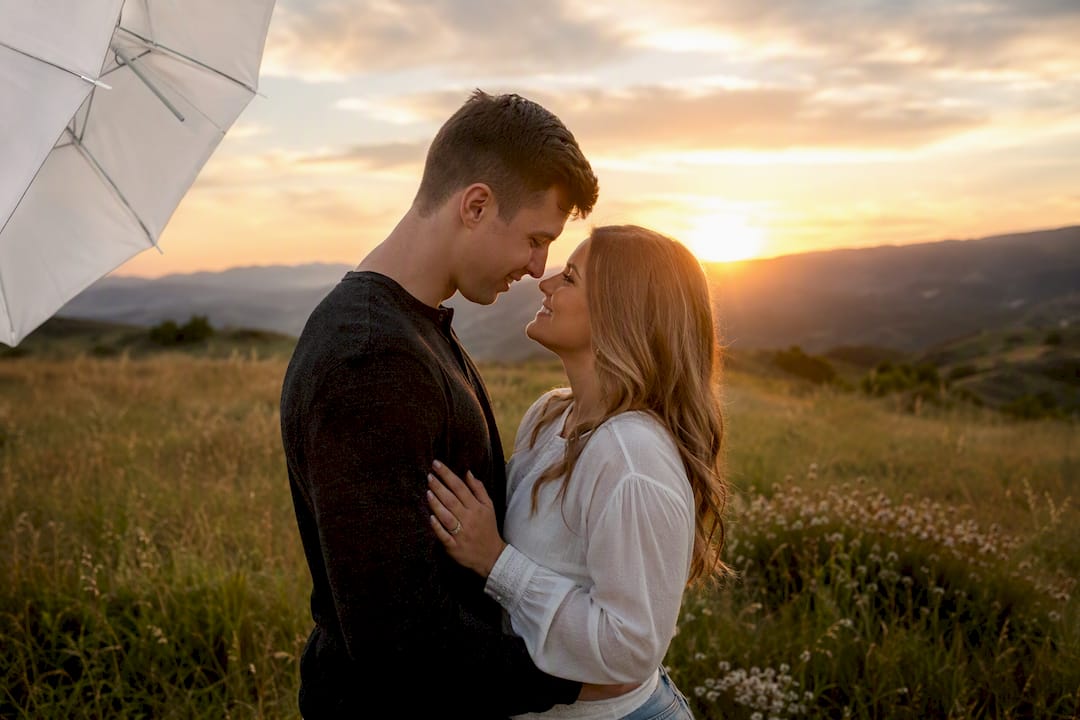
The practical result is what photographers often call a natural softbox. Near the horizon, the atmospheric path length is roughly 38 times longer than it is at noon, which spreads and softens the light source itself. Shadows lose their hard edges, skin tones even out, and the light comes in low and directional, wrapping round faces instead of flattening them. How long that window lasts depends on where and when you marry. Couples near the equator get a shorter, sharper golden hour, while those further north or south, especially in summer, get a longer, gentler fade.
When exactly should you take your wedding photos?
The reliable way to nail this is backward planning: start from sunset and work back, not forward from the ceremony.
- Look up the exact sunset time for your venue's coordinates, not the nearest city. Local topography, trees, and buildings can block the sun well before the official time.
- Set your portrait session to end at sunset.
- Book the session to start 30 to 60 minutes before that, depending on the season and how open your venue's western view is.
- Add a 15 to 20 minute buffer on top, because formals almost always run late.
Say your venue's sunset is at 8:15pm in June. Your portrait slot would run from roughly 7:15pm to 8:15pm, with the couple arriving by 7:00pm to allow for the walk to location and a breather beforehand.
The most reliable way to check this is a dedicated sunset or golden hour calculator rather than a general weather app, since these often default to citywide figures. It's also worth noting that once the sun actually dips below the horizon, you're into civil twilight, and ambient light falls away quickly, so don't assume you'll get another twenty minutes of usable brightness on top.
Pro Tip: Finalise this slot with your planner and every vendor at least two months before the wedding and mark it as protected time on the schedule, the same way you'd protect the ceremony start time. It's the single easiest way to stop golden hour quietly disappearing under a delayed dinner service.
While the full golden hour can stretch close to 90 minutes, the light most couples fall in love with is concentrated in that much tighter 20 to 45 minute band nearest the horizon.
Building golden hour into your wedding day timeline
Two templates cover most weddings. A sunset-centred timeline treats the couple's portraits as the day's creative peak: ceremony early afternoon, reception drinks and speeches slotted before sunset, then a clean 30 to 45 minute break where the couple slips away together while guests continue the party. A guest-inclusive timeline brings everyone along for part of it, guests get a golden hour toast or lawn games while the couple grabs 15 to 20 minutes of private portraits nearby, then rejoins for photos with the wedding party as the light fades.
Whichever you choose, tell the right people early:
- Your coordinator, so they can hold the timeline against caterers and the venue
- Your photographer, who needs the confirmed slot to plan locations and backup lighting
- Your DJ or band, so they don't schedule the first dance over your window
- Parents and the bridal party, briefed simply: "we're disappearing for twenty minutes around sunset, please don't pull us for anything else then"
Build in a buffer for the usual culprits, family formals overrunning and a vendor arriving late, by placing golden hour after the riskiest parts of the day are already done. If timing is tight, moving a first look earlier in the afternoon banks safe daylight portraits and takes the pressure off sunset entirely.
How do you make the most of the light on the day?
Scout locations with a clear, unobstructed western view rather than the prettiest spot on the map, since trees or buildings can cut your window short even when the sunset time itself is accurate. Somewhere with quick access from the reception matters more than distance, every minute walking is a minute of light gone.
- Keep posing direction simple: a few words, a bit of movement, genuine reaction over a held stare
- Shoot wide environmental frames first while the sun's still above the horizon, then move tighter as it drops
- Save close portraits and backlit silhouettes for the final minutes, when the light is warmest
- Earth tones and muted jewel tones catch golden light beautifully; avoid heavily reflective sequins or metallics that throw odd flares
- Veils and flowing fabric come alive when backlit, so let them move
A phone can capture a nice snap, but a proper camera still handles the shift from warm daylight into blue-hour dusk far better, holding detail in a bright sky and a shadowed face at once where a phone sensor struggles. If you're grabbing your own shot, shoot with the sun behind your subject and tap to expose on their face rather than the sky.
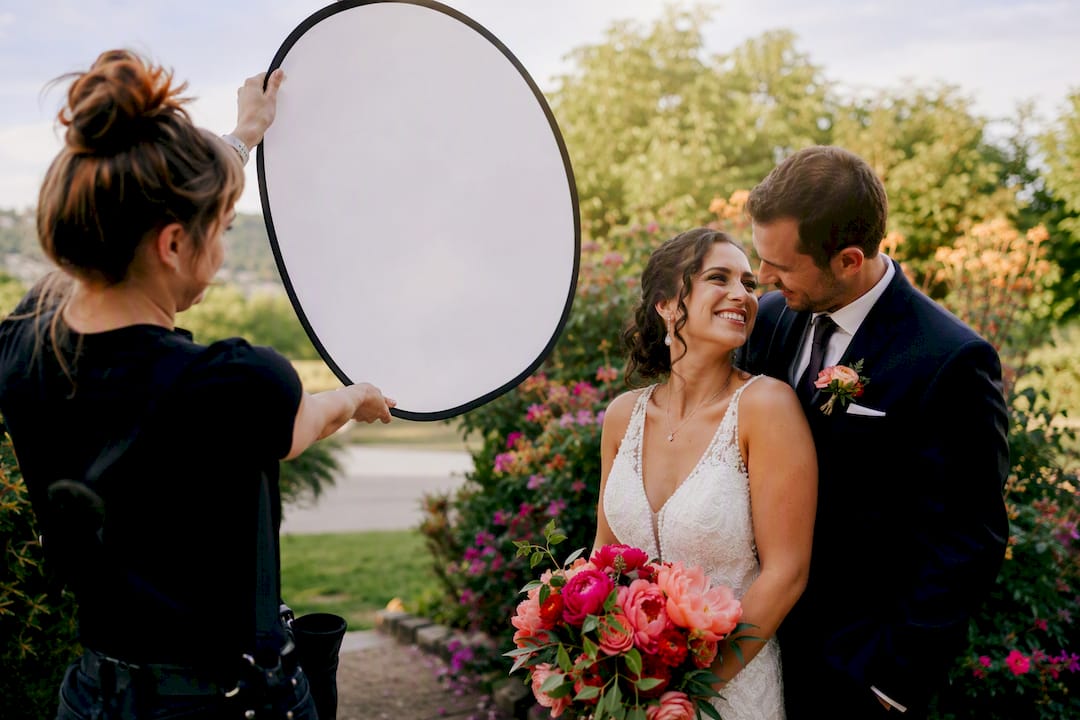
Pro Tip: A simple reflector, or a touch of gentle fill flash, helps enormously once the sun has properly dipped and faces start to lose light before the sky does. Ask your photographer whether they'll be using one, it's a normal part of a well-run golden hour session, not a sign anything's gone wrong.
Will you miss your own party for golden hour?
No, not really. A well-planned session runs 15 to 20 minutes for a quick sneak-away, or up to 45 minutes if you're building it into the timeline properly, and either way you're back in time for dancing.
- Overcast skies? You lose the amber glow but gain even, flattering diffusion, often more forgiving than a harsh, low sun.
- Storms or rain? Move indoors and lean on window light or warm-toned flash rather than cancelling portraits altogether.
- Missed the window entirely? Prioritise family formals earlier in the day and let couple portraits happen whenever the light next allows, even the next morning if you're staying near the venue.
How does a professional actually run a golden hour session?
Alex Gell's approach starts before the wedding day, pre-scouting the venue at the same clock time as the ceremony to check exactly where the light falls and which spots keep a clear western view. On the day, that means a rehearsed timeline, a compact lighting kit for backup fill, and a shooting order that moves from wide environmental frames to tight portraits as the light warms and drops.
- Confirm the venue's exact sunset time, not the city default
- Walk the location at the right time of day beforehand
- Build a 30 to 45 minute buffer into the printed timeline
- Brief the coordinator and bridal party on the "quiet disappearance" plan
Couples consistently point to the sunset portraits as the images they return to years later, the ones that make an album feel like a genuine moment rather than a posed record.
The full range of results sits in the wedding photography portfolio, including the golden hour session from Tom and Amanda's wedding at Asylum Chapel and The Sail Loft.
A quick word from behind the camera
I plan every wedding day around getting you the best light, not the easiest schedule, and I'll handle the logistics so you just enjoy the twenty minutes. Have a look through the portfolio or get in touch if you'd like to talk through your own timeline.
Ready to book your golden hour session?
Alex Gell is based in Berkshire and works across London, Berkshire, and Oxfordshire, which matters here because sunset timing genuinely depends on local geography, not a generic online calculator. Rather than treating golden hour as a nice extra, every wedding booking is built around protecting that window from the first timeline draft, with pre-scouting and a backup lighting plan already worked in rather than improvised on the day.

When you enquire, ask three things: whether the photographer has worked at your venue or a similar one before, what their specific plan is for your golden hour slot, and what backup lighting they'll bring if the weather turns. Couples marrying in Berkshire can start with the Berkshire wedding photography page, and London couples can check availability through the London wedding photographer page. Whichever route suits you, the fastest way to lock in your date and timeline is through the wedding enquiry page.
Sources
- Why does golden hour light look so good? — LightCast
- How to build a wedding day timeline that protects the golden hour | FindMe Photo
- How to plan golden hour wedding photos: Timing, tips & what to tell your photographer — Plan A Wedding
- Why the golden hour is the best time of day for photographs — James Thomas Long
